Research highlight
Fabrication and Characterization of Two-Layered PZT–ZrO₂ Discs Through Cold Isostatic Pressing for Improved Life
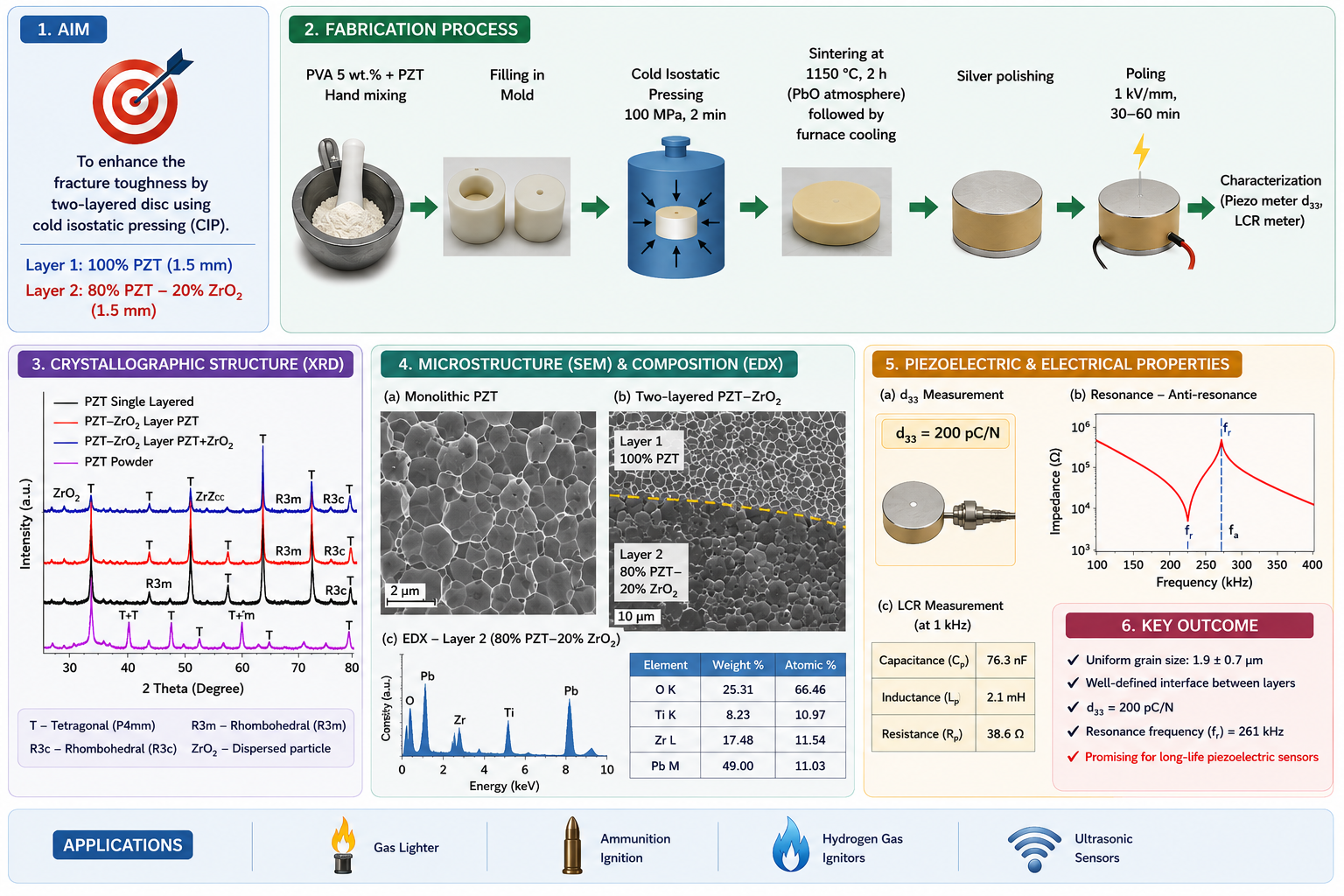
A two-layer PZT–ZrO₂ composite fabricated using Cold Isostatic Pressing to improve fracture toughness while retaining piezoelectric performance.
Research in 30 Seconds
Research Problem
Conventional PZT ceramics exhibit excellent piezoelectric performance but are inherently brittle. This work explores whether a two-layer composite structure can improve fracture toughness without compromising electrical performance.
Approach
A two-layer PZT/ PZT–ZrO₂ disc was fabricated through Cold Isostatic Pressing, followed by sintering, silver coating, and electrical characterization. Structural, microstructural, and piezoelectric analyses were then performed.
Techniques Used
Key Findings
- •Successfully fabricated a well-bonded two-layer PZT–ZrO₂ composite.
- •Maintained a clear interface between the two ceramic layers.
- •Achieved d33 ≈ 200 pC/N after electrical poling.
- •Resonance frequency measured around 261 kHz.
- •Demonstrated potential for durable piezoelectric sensor applications.
Publication Details
Journal: Springer Book Chapter
Year: 2025
Authors: Saurabh Khare, Nandani Rai, Nikhil Dilip Kulkarni and Poonam Kumari
DOI: 10.1007/978-981-96-9513-3_4